THICK PLATE WELDING AUTOMATION
Robotic Welding Fails on Thick Plate for One Reason: Process Instability
If your robotic welding cannot hold UT/RT standards on 6mm–100mm+ structures, the issue is not programming. It is thermal behavior, deformation, and joint variation breaking repeatability.
For OEM and heavy fabrication teams facing inspection failure, distortion, or unstable robotic weld performance.
Why Robotic Welding Becomes Unstable on Thick Sections
Most robotic welding failures on thick plate are not programming problems. They are process instability problems that only appear under real production conditions.
Heat Accumulation
Multi-pass welding builds up heat that cannot dissipate, causing the weld pool to behave unpredictably.
Structural Deformation
Thermal expansion and contraction distort the geometry, making the programmed path no longer valid.
Joint Variability
Gap variation, misalignment, and fit-up inconsistency break repeatability across weld passes.
Stabilizing Robotic Welding in 6mm–100mm+ Sections Under Real Conditions
Stability requires controlling heat, maintaining geometry, and adapting to joint variation in real time during production.
The system operates through three coordinated control layers:
01 — Thermal Control
Heat input is actively controlled across passes to prevent accumulation.
Interpass temperature and welding parameters are continuously adjusted in response to thermal behavior during welding.
02 — Geometric Stability
Deformation is predicted and compensated during welding.
The system maintains alignment between programmed paths and actual structure despite ongoing thermal distortion.
03 — Adaptive Tracking
Seam position is continuously scanned and corrected in real time.
Welding parameters and path are dynamically adjusted during the welding process to respond to joint variation.
Proven Under Real Thick-Section Production Conditions
The system has been applied to thick-section welding under real production constraints.
01 6mm–100mm+
Multi-pass welding under heavy-section conditions
02 Consistent UT/RT Pass Rates
Stable ultrasonic and radiographic inspection results
03 Controlled Distortion
Reduced deformation and post-weld correction
04 Repeatable Production Output
Stable welding performance across long production cycles
System operating under real production conditions:
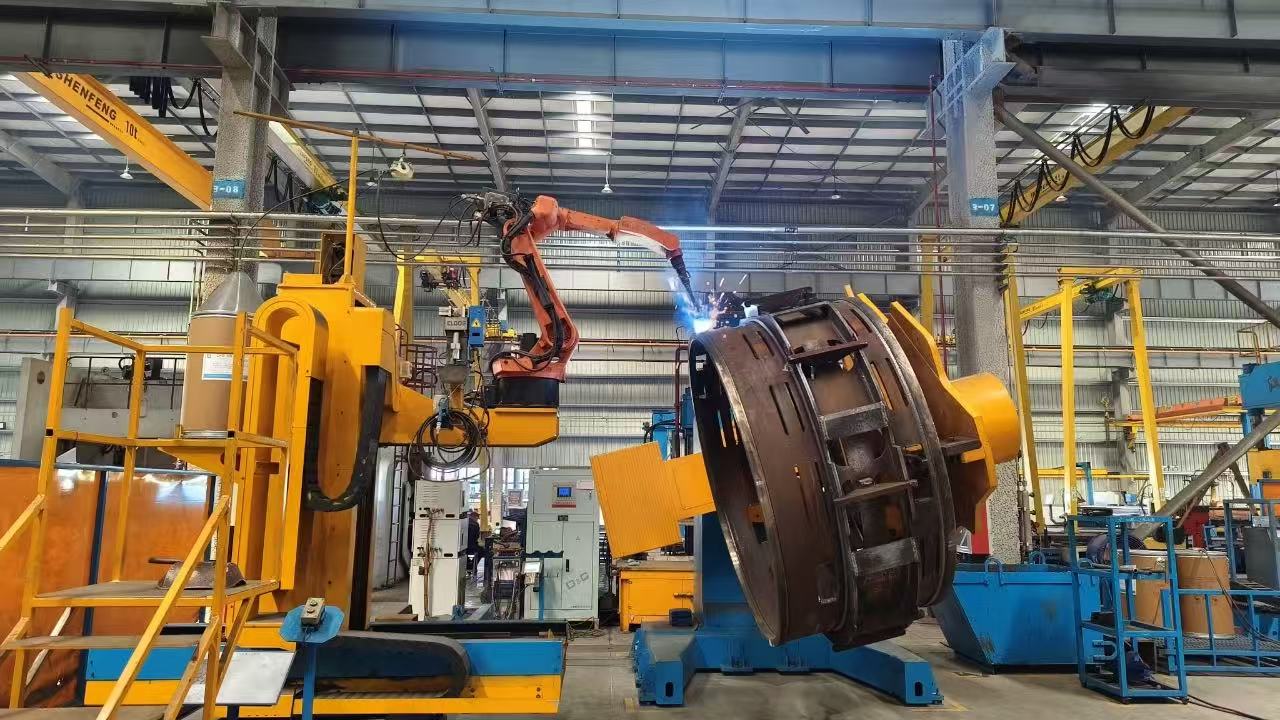
Real-time seam tracking and adaptive welding control during thick-section production welding.
System Operation Under Real Production Conditions
Real-time seam tracking and adaptive welding control during thick-section production.
Real-time seam tracking and adaptive parameter control during thick-section welding under production conditions.
Key Questions About Thick-Section Welding Automation
These are the most common concerns from engineering and production teams before implementation.
Can your system handle very thick sections (e.g. 50mm+ or 100mm+)?
Yes. The system is specifically designed for thick-section welding, including multi-pass processes up to and beyond 100mm, where thermal accumulation and deformation are critical challenges.
How do you ensure consistent weld quality under variable conditions?
The system continuously monitors joint conditions and adjusts welding parameters in real time, maintaining stability despite heat buildup, deformation, and fit-up variation.
What is the typical lead time for system delivery?
Lead time depends on system complexity and project scope. Typical delivery ranges from 10 to 16 weeks, including system integration, testing, and validation before shipment.
How is after-sales support handled for overseas projects?
We provide remote technical support for system optimization and troubleshooting. For installation and commissioning, our engineers can be dispatched on-site if required.
Standard components such as robots and welding equipment are globally supported by their original manufacturers.
In addition, commonly used spare parts and consumables are stocked in regional locations including Canada, Denmark, and Japan, reducing downtime and ensuring faster response.
Do we need to replace our existing robots or welding equipment?
In many cases, existing robotic systems can be upgraded or integrated into the solution. Required modifications depend on your current setup and performance requirements, which are evaluated during the technical assessment.
Can the system be supported remotely after installation?
Yes. Most system adjustments, parameter optimization, and troubleshooting can be handled remotely through secure connection. On-site support is available when required.
What happens after I request a technical assessment?
We review your welding process, identify instability sources, and provide a clear evaluation with recommended next steps. This can be done remotely or on-site depending on your requirements.
Still unsure if your process can achieve stable, inspection-ready welding? Submit your case for evaluation.
Request a Technical Assessment for Your Welding Process
We identify instability sources and define a clear path to stable, inspection-ready welding production.
Response within 24 hours. Remote evaluation or on-site support available.
Get a Technical Evaluation of Your Welding Process
Describe your welding challenges, and we will evaluate stability risks and recommend a practical path to consistent production.
Suzhou Aoguan Intelligent Equipment Co., Ltd. (AGR Robotics)
Head Office: Suzhou, China | Offices: Japan, Denmark, Canada
Robotic welding systems engineered for thick-section structural applications.
- Privacy Policy
- Terms of Use
- Contact